June 2026
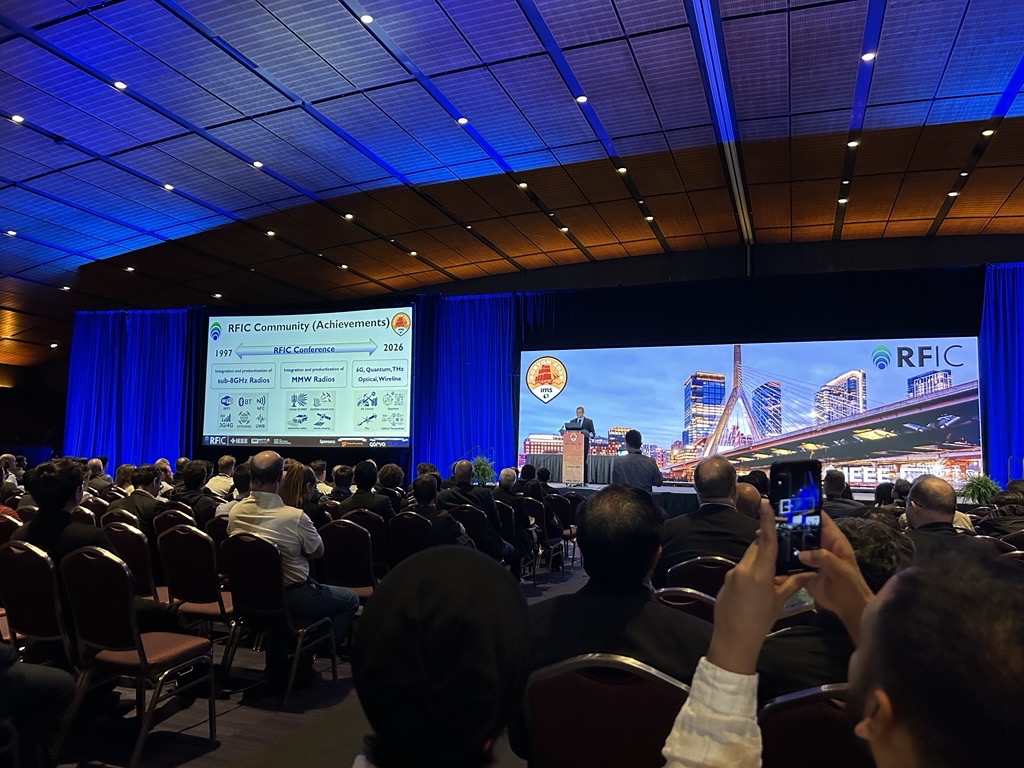
Last week, our co-founder and CTO Dr. Shailesh Kulkarni took the stage at IEEE IMS/RFIC 2026, the IEEE‘s flagship conference for RF and microwave technology, to present our work on phased array architectures for satellite communications.
His presentation, “Phased Array Solution for SATCOM: A Modular Approach where SATCOM meets bulk CMOS”, was part of Workshop WSM-6: “RFICs in Space: Design Techniques Enabling Satellite Communications and Sensing in Harsh Environments”, a fitting home for a talk that sits at the intersection of advanced IC design and the real-world demands of next-generation satellite ground terminals.
As LEO and MEO constellations move toward commercial deployment, the engineering constraints on ground terminal RF front-ends are becoming harder to ignore. Terminal manufacturers face pressure on three fronts: performance, cost, and manufacturability. A monolithic approach to phased array design anchored in complex premium manufacturing processes has a hard time to satisfy all three.
A modular phased array architecture built on highly integrated mainstream CMOS ICs, offers a more actionable path. Based on this approach, terminal designs can scale in aperture size, beam count, and production volume, without forcing a full redesign or running into cost and scaling issues inherent to complex, single-sourced manufacturing alternatives. The antenna front-end becomes a system built from well-characterised, reusable building blocks rather than a custom engineering effort for every new programme.
None of this is achievable without the right manufacturing partners. Combining the robustness and scalability of their mainstream CMOS manufacturing processes with TUSK IC’s deep RF-CMOS design expertise, our products deliver the power efficiency and cost structure that commercial and government/defence terminal programmes actually require. Being a startup in execution mode has not changed our conviction that pushing innovation is essential to set a new power-performance baseline for Ka-band front-ends.
An invitation to present at IMS is a meaningful signal. It reflects not just the quality of our work, it also reflects the relevance of the problem we are working on. The satcom ground terminal space is drawing serious attention from the RF and microwave community, and rightly so. The volume of terminals that LEO broadband constellations will require is unlike anything the industry has previously had to supply.
For TUSK IC, IMS 2026 is one milestone in a longer journey. We are grateful to the IEEE and the workshop organisers for the platform, to ESA and Flanders Investment and Trade for their financial support, and to everyone who attended the session or reached out afterwards.
If you missed the presentation and would like to discuss our approach to phased array antennas in more detail, get in touch at info@tusk-ic.com.